Wednesday, 11 May 2011

Boat Moved

13th April my Snapdragon 27 Yacht was moved by road. I used D&D Transport based in Ardleigh, near Colchester, Essex, UK

All went well, though it took a few attempts to get the yacht sit sit properly in the new castor fitted yacht cradle. The yacht was not in the boat yard slings quite square, so when her keel weight was in the cradle she kept twisting slightly. Using brute strength of four men and a bit of rope we got it squared up.

The journey was about 35 miles and took about an hour. We went slowly to avoid the rock bouncing about too much on the giant truck; which was 60ft long and had a 65 tonne crane! We got her to her new farmyard home and got her unloaded from the crane. I used the towball on my car to position the cradle in the barn (Ardtalla's new home for the next year).

Just before the move

Update

I have been away from the boat and site for a while.

I have been studying hard, and went on vacation to Barcelona. I of course checked out Barcelona Marina to check on the yachts there!

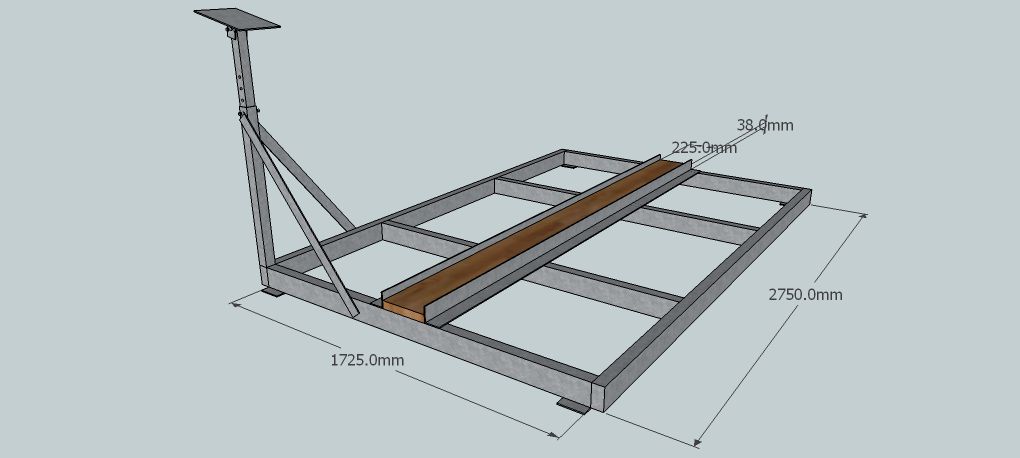
I'm getting the boat moved so it is a bit closer to me, and therefore have more time to work on her. This will save me two hours of travel and heaps of petrol money! It's taken me weeks to find a friendly farmer with a spare barn, and a lorry with a Hi-AB crane that won't charge stupid amounts of money. I have also been designing a new yacht cradle that I can fit castors to so I can get in in and out of the barn as needs be.

Design Stages (Sketch-up)

New Book

Currently reading this book 'This Old Boat Second Edition) by Don Casey. I'm finding that it has lots of information and ideas that I would have never came up with. It is helping planning the project and what to expect and budget for.

As Bought

Photos of my Snapdragon 27 Yacht when i bought her in August 2010.

She looks very different now! All the insides have been gutted out and she is sitting in a barn I am renting.


Welcome

Welcome To Goodtarp.Com


Welcome to goodtarp.com My own little place on the internet.

This site will track my progress on refitting a Snapdragon 27, from the big monotonous jobs, to the little annoying ones. I hope this site will help fellow Snapdragon owners, and give a chance to brainstorm with other boat owners with similar size vessels.

I bought my Snapdragon in August 2010 after searching for 5 months for a suitable DIY project. It is my aim to fit the vessel to make it habitable as a liveaboard and eventually as a long distance blue water cruiser for travel to Australia via the Atlantic and Pacific oceans. I am studying two part time degrees at the moment with Westlawn and MPI. Small Ship/Yacht Design, and Marine Surveying.


Yanmar YSE YSB YSM 8 12 Engine

My Snapdragon 27 Yacht is fitted with a Yanmar YSE12 Engine. This is very similar to the Yanmar YSM, YSE8, YSB8, YSB12 Engine.

I am going to rebuild the engine and will document the process on this website.

The 'E', 'B', 'M' I believe stand for 'Early' 'Between' 'Modern' versions of the engine. The YSE & YSB are very similar, with the YSM having a different design and ancillaries. The main difference I have noticed on the YSE and YSB is the thermostat housing or 'Water jacket', on the top of the engine. There is an identifying plate on top of the flywheel housing.

Originally designed as a flat twin, made by Coventry Climax in the mid 1930s; designed to go in the stern of landing craft, these engines were made so servicing could be from the front, the engines low height allowing them to be tucked away in the stern. Yanmar made the modified design for a single in 1974, making the YSE from 1974 to 1977. Modifications were made for the YSB for 1 year, before a redesign, including a different fuel injection pump for the production of the YSM from 1978 until ceasing production in 1980.
The YSE & B have a fuel injection pump bolted onto the front of the engine, while the YSM has a different type of pump, which is bolted in the cylinder block. Another difference is the front pulley is on a layshaft on the YSE & B, only being on the crankshaft on the YSM.
The engine is raw water cooled only, so operates at a low temperature. The engine should not be run slowly for long periods; the manual states to run flat out for an hour after trawling for a few hours. The oil level can be critical, as reports of oil blow by causing the engine to race out of control seem common. This is when the engine runs on it's own lubricating oil, instead of the diesel fuel.

The engine has no oil filter, relying on an oil strainer. This consists of a series of thin rings on a shaft that is turned by a T handle on the front of the engine. Thin plates between the rings; scrape the debris from the oil. The dipstick is on the oil filler, both for the engine and gearbox. Levels should be taken with the screw filler caps resting on the threads, not screwed in. Care should be taken however, as the engines are not always mounted level in the boat.

The manual states 30sae oil, but multigrade oil can be used, as this oil is superior, and was not around when the engine was manufactured. Care should be taken to only use a mineral oil, and not one of the synthetic, or semi-synthetic oils around today. These can damage the bearings of older engines.
The YSE and B have a poorly designed govenor. A needle valve in the pump releases the injection pressure, hence only about 1/3 of a turn of a fine threaded bolt is required from full throttle to stop. After all these years, the needle valve seats are worn in the pumps, causing erratic running, stopping, and poor starting. New needle valves are readily available though.

The gearbox of the YSEs can be 2 to 1 or 3 to 1 reduction (3 to 1 has a 'G' designation at the end of the engines model number of chasis plate). The reverse is very slightly lower geared, but on mine with 2 to 1 gearing, there is little noticeable difference in engine speed. The engines maximum speed is specified as3000 rpm.

The engine is noisy engine, however it is economical, using approx. 1 to 1 1/2 litres of diesel an hour.
Despite their age, parts are still readily available for these engines, although the cost of repair is becoming uneconomic in some cases, according to some people I have been in contact with.


The majority of this information came from: http://www.angelfire.com/rnb/malcsworld/boat/YanmarYSengines.html

Snapdragon / Mirage History

Historical Information

1959 Thames Structural Plastics formed in Rayleigh, England.
1962 Thames Structural Plastics moved to Southend, England. First sailing cruiser launched 'Snapdragon 23' centre-boarder.
1964 Thames Structural Plastics moved to Canvey Island, England. Factory becomes larger and company changes to 'Thames Marine'.
1968 'Snapdragon 21' and 'Snapdragon 29' launched.
'Snapdragon 29' is later modified and renamed 'Snapdragon 890'
1968-1974 Snapdragons 600, 670, 24, 26, 27 are launched.
License given to 'Isles of Norbury' to build and sell 'Snapdragon 670' marketed as "Invader".
1975-1980 Mirages 27, 28, 29, 30 and 37 launched.
1981 Thames Marine stops manufacturing. Marketing and Distribution taken over by ' Maplin Marine'.
Maplin Marine stops trading after twelve months.
'Boating Scene' takes over Mirages and Snapdragon 890's.
Historical Information obtained from Snapdragon Mirage Association